


A widespread cyberattack has exposed visitors to 178 organizations’ websites to malicious code capable of redirecting cryptocurrency payments, stealing payment card details, and collecting other sensitive information as hackers inject crypto-staling malware. Major names affected include HSBC, the BBC, Salesforce and hardware wallet manufacturer Ledger.
The campaign exploited a vulnerability in Optimizely’s website optimization platform, allowing an attacker to insert malicious JavaScript into customer projects without directly breaching the affected companies’ own servers. Although the code has reportedly been removed and the flaw fixed, the full extent of the damage remains unclear.

Optimizely Vulnerability Exposed Hundreds of Websites
According to cybersecurity firm Report URI, the attacker took advantage of a weakness in Optimizely’s account registration process on November 16. The platform allows businesses to experiment with website layouts and content by embedding its JavaScript code into their pages.
By compromising the vendor’s software, the attacker was able to distribute malicious instructions through websites that relied on Optimizely. This meant visitors could encounter the harmful code simply by opening an affected page.
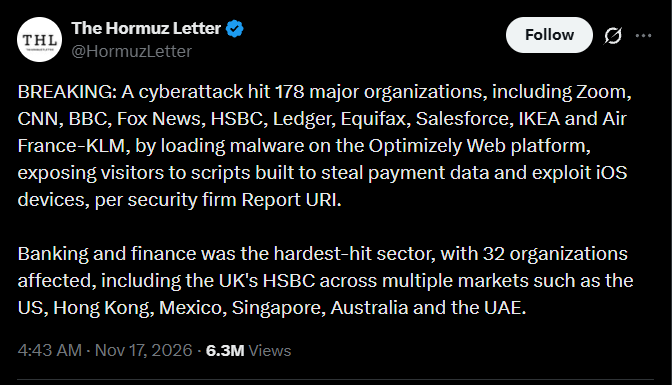
The incident involved 178 organizations, including HSBC, Salesforce, the BBC and Ledger. Optimizely confirmed that an unauthorized party had exploited its signup process to insert rogue code into customer projects. The company said it removed the malicious payload and addressed the vulnerability.
The attack highlights the risks associated with third-party website services. Even when an organization’s own infrastructure remains secure, compromised external tools can create an entry point that exposes its visitors.
Malware Redirected Crypto Payments and Collected Financial Data
The malicious script was built to identify cryptocurrency wallet addresses displayed on affected websites and replace them with addresses controlled by the attacker. It targeted several networks, including Bitcoin, Ethereum, Solana and Tron, as well as five other blockchain networks.
The code could modify addresses in website forms and text copied to a visitor’s clipboard. As a result, someone attempting to make a legitimate crypto payment could unknowingly paste the attacker’s address into their wallet and approve a transfer to the wrong destination.
However, the campaign extended beyond cryptocurrency theft. The script also collected payment card numbers entered into website forms, copied cookies and captured screenshots. It additionally delivered exploit kits targeting older iPhones.
Six of the affected organizations identified by researcher Scott Helme were crypto or trading-related businesses. These included Ledger, IG Group Holdings, OANDA’s Coinpass, Interactive Investor, TMS Brokers and Betashares. Another 32 affected organizations were banks and financial companies.
Report URI reported that wallets associated with the campaign had received approximately $7,040, primarily in Bitcoin, by Monday evening. The figure had not been independently verified by Bloomberg, while the total amount of information collected and potential financial losses remained unknown.
Third-Party Software Continues to Create Security Risks
One of the most concerning aspects of the incident is that attackers did not need to compromise the individual websites directly. Instead, they exploited a trusted service used by multiple organizations, allowing malicious code to reach visitors across a much wider network.
Hudson Rock, a cybersecurity firm specializing in infostealer malware, also identified similar code being distributed through three other web services. Its findings suggested that the activity extended beyond the Optimizely incident, with an earlier wave detected on November 13.
Address substitution is a known cryptocurrency theft technique because it targets the payment process rather than the wallet itself. A wallet can operate normally and approve a transaction as intended, but the user may still lose funds if the destination address has been secretly changed before the transfer.
So far, researchers have not linked the campaign to artificial intelligence tools. Optimizely attributed the incident to a vulnerability in its signup process, while the investigation into the attack continues.
The incident also comes amid growing concerns about software vulnerabilities and AI-assisted cyberattacks. Google’s threat intelligence team reported that monthly vulnerability disclosures roughly doubled between January and July, adding to concerns about the expanding security risks facing online services.
With hundreds of organizations relying on shared website infrastructure, the incident serves as another reminder that security risks can extend far beyond a company’s own systems. For cryptocurrency users, checking wallet addresses carefully before confirming transactions remains particularly important.
Do you think third-party website providers should face stricter security requirements after incidents like this? Could address-swapping malware become a more serious threat to everyday crypto payments?

Editorial Process for bitcoinist is centered on delivering thoroughly researched, accurate, and unbiased content. We uphold strict sourcing standards, and each page undergoes diligent review by our team of top technology experts and seasoned editors. This process ensures the integrity, relevance, and value of our content for our readers.