

Binance says it has replenished approximately 95% of the $6.3 billion in cryptocurrency stolen during a record-breaking hack, using its own reserves and corporate funds to replace the affected assets. The exchange has also begun gradually restoring withdrawals, pledging to absorb the financial losses rather than pass them on to customers.
Binance, the world’s largest cryptocurrency exchange, said on November 1 that it had replaced approximately 95% of the assets affected by the $6.3 billion security breach, up from the 90% reported a day earlier.
In an update posted on X, co-CEO Richard Teng said the exchange had begun a phased resumption of withdrawals, taking a cautious approach to ensure services could return safely and securely.
Teng reiterated that Binance would cover the financial impact of the stolen funds, emphasizing that customers would not bear the losses.

“We’ve now replenished approximately 95% of the impacted assets, and our commitment remains clear: Binance will absorb the financial impact of the stolen funds, not our users,” he said.
The latest update marks further progress in Binance’s recovery efforts following one of the largest cryptocurrency thefts on record.
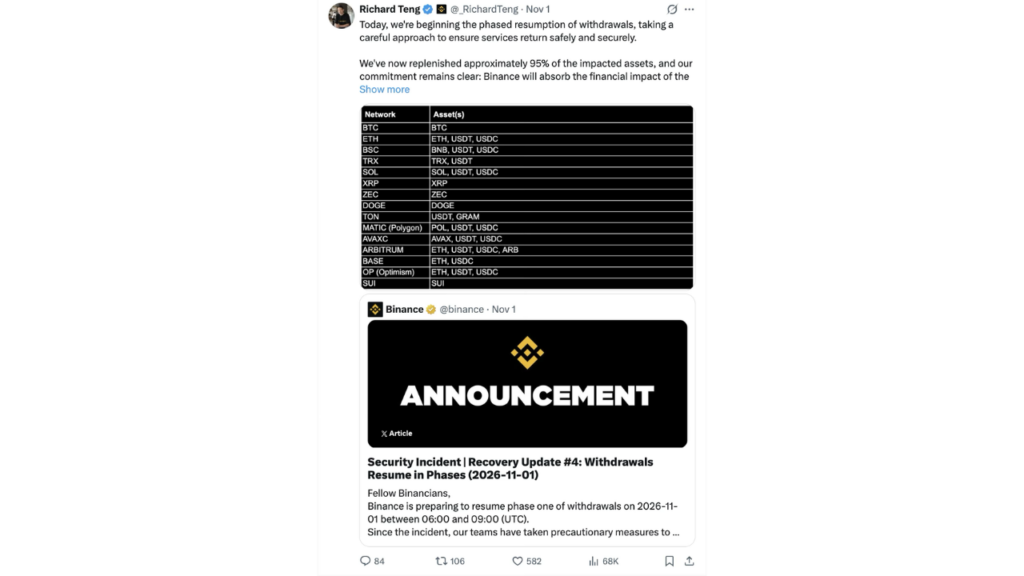
Co-CEO Richard Teng’s Statement on X
Binance uses SAFU reserves and corporate funds
Binance said it had set aside approximately $6.34 billion in company funds to cover the losses. The money used to repurchase the stolen tokens came from three sources: its Secure Asset Fund for Users (SAFU), Futures Insurance Fund and corporate treasury.
The SAFU fund, designed to protect customers in the event of security breaches and other unexpected incidents, holds approximately $1 billion in reserves. Binance used part of this fund alongside its insurance resources and corporate capital to replenish the affected assets.
The exchange’s strategy involves purchasing replacement tokens rather than simply compensating customers with cash. However, completing the process has proved more difficult for certain cryptocurrencies.
Binance is continuing to replenish the remaining 5% of affected assets. The exchange had previously said that less-liquid tokens could take longer to acquire in large quantities without significantly affecting market prices.
Despite the delay, the exchange maintained that customers would not suffer financial losses from the incident. Its commitment to absorb the cost is intended to prevent the breach from directly affecting customer balances.
Exchange works to restore normal operations
The security incident also disrupted Binance’s services, prompting the exchange to temporarily suspend customer withdrawals while it assessed the breach and worked to secure its systems.
The restriction raised concerns among users, particularly given the unprecedented value of the stolen cryptocurrency. However, on November 1, Binance began a phased resumption of withdrawals, taking a cautious approach to ensure services returned safely and securely.
Co-CEO Richard Teng previously described the breach as a complex attack involving a compromised laptop and malicious software designed to erase evidence of its activity. The use of such software made the incident more difficult to trace and investigate.
While Binance has not disclosed all the technical details surrounding the breach, its latest update suggests that the exchange has made substantial progress in addressing the immediate financial consequences.
Restoring withdrawals will be an important step in rebuilding customer confidence, particularly as users look for reassurance that their funds remain accessible and adequately backed.
Binance updates proof of reserves
Alongside its recovery efforts, Binance announced a new snapshot of assets held on its platform as of 00:00 GMT on October 31, as part of its proof-of-reserves process.
The exchange said customers holding 10 supported cryptocurrencies would be able to verify that their assets were backed at a minimum ratio of 1:1 once the full proof-of-reserves information became available.
The listed assets include Bitcoin (BTC), Ethereum (ETH), Tether (USDT), BNB, Solana (SOL), USD Coin (USDC), XRP, USD1, RLUSD and Zcash (ZEC).
Proof of reserves allows cryptocurrency exchanges to demonstrate that they hold sufficient assets to cover customer balances. Binance’s latest snapshot is intended to provide additional transparency following the breach and reassure users about the exchange’s ability to meet its obligations.
However, proof of reserves does not necessarily provide a complete picture of an exchange’s financial position, as it may not account for all liabilities.
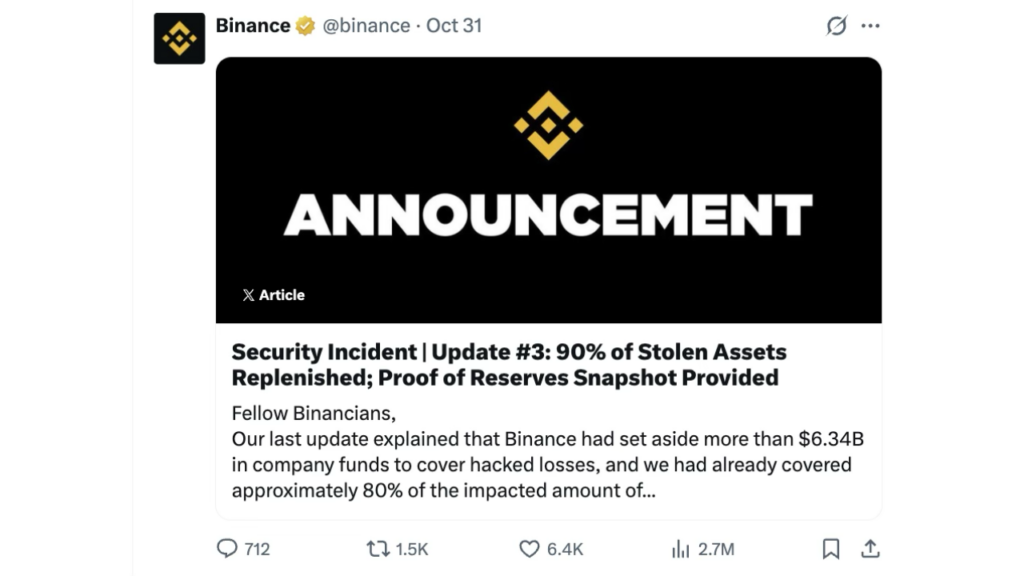
Binance Updates Proof Of Reserves (Source: X)
A major test for Binance’s credibility
Replacing approximately $6 billion in stolen cryptocurrency represents a substantial financial commitment, even for an exchange of Binance’s size. By drawing on its reserves, insurance funds and corporate treasury, the company is attempting to contain the damage and prevent the incident from turning into a broader customer confidence crisis.
The remaining challenge is to acquire the less-liquid tokens while restoring normal operations and maintaining transparency over its reserves.
Although Binance has already replaced most of the stolen assets, the incident highlights the financial and operational risks facing centralized cryptocurrency exchanges. Even the industry’s largest platforms remain vulnerable to sophisticated attacks, making security, asset protection and transparency critical to maintaining user trust.
Whether Binance can fully deliver on its commitment will be an important measure of how effectively major crypto exchanges can manage the financial fallout from large-scale security breaches.