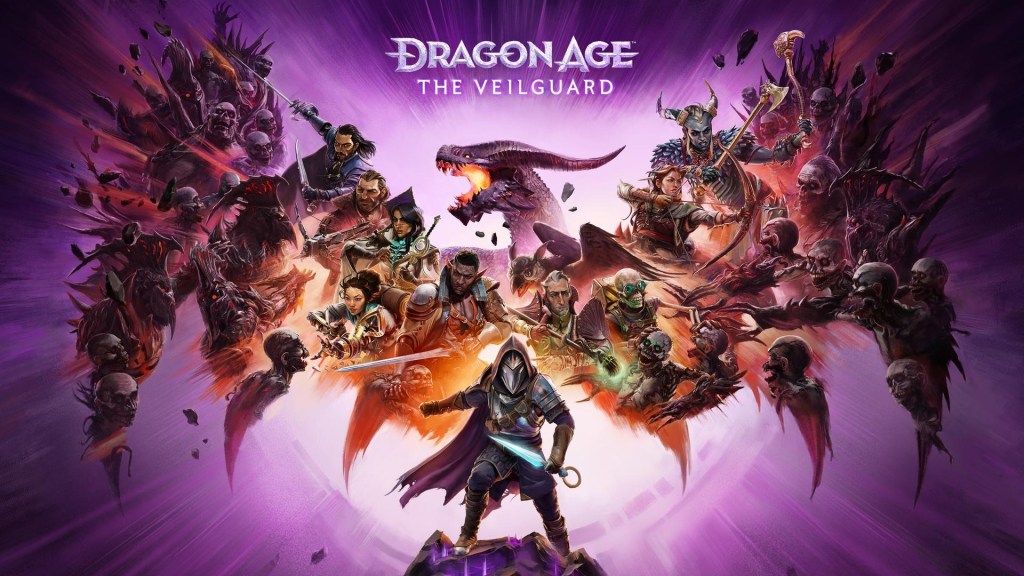


A BioWare game is a tricky thing to review. There’s a slightly different balance than there is in other games and the players expect — nay, demand — certain things that they might not care about or even consider in other titles. So I feel compelled to give Dragon Age: The Veilguard two different ratings: One, for how good, fun and playable it is overall as a game; and two, how satisfying and enjoyable it is as a BioWare title. Since that’s not really an option, I’ll try to condense that opinion by saying that it’s a very good game, possibly at the expense of being a good BioWare game.
Dragon Age: The Veilguard is the latest game in one of BioWare’s flagship series, for which fans have waited nearly a decade. Taking place ten years after the events of Inquisition, the titular group of characters band together under the leadership of player character Rook to stop Solas, a companion from the previous game with designs on world destruction. However, their attempts to stop him inadvertently unleash a much greater evil, which Rook and company will have to rock-and-roll all over Thedas attempting to stop.
When I got the chance to preview the game, I listened to several of the developers speak about Veilguard’s development and what they wanted to focus on while making it. Not only were they all adamant that Veilguard was going to “go back to BioWare’s roots,” but they were also honest about their hopes that doing so would revive the studio’s bruised reputation. Following the mixed reception to Mass Effect Andromeda and the out-and-out failure of Anthem, BioWare fell from the lofty position in which many gamers held it. But is any one game enough to change that?
In theory, a new Dragon Age game is an ideal candidate to do that: Previous title Inquisition is the best-selling BioWare title of all time, sitting at 12 million lifetime sales. And The Veilguard did make it into Circana’s top 10 best-selling games in the U.S. for October despite releasing at the end of the month. That said, Circana analyst Mat Piscatella said in an interview with IGN that the game had a “good — but not great — launch” and that it would face “a bit of an uphill battle to reach Inquisition’s lifetime sales.”

Welcome back to Thedas — who’s in charge here?
Before I go on, let me specify that most — nearly all — of the previous decisions made in the other titles in this choice-heavy series will not matter in Veilguard. This is a mild spoiler, though you’ll figure it out as soon as you boot up the game and see all of the three questions the game asks you about what choices you made in Inquisition. I’d be lying if I said — as a Dragon Age fan and lore junkie — it isn’t a bit disheartening to realize that so many of your choices in the three previous games ultimately don’t lead anywhere.

But as a game critic and follower of the industry, I kind of respect BioWare for it. If you think about it, The Veilguard is spinning a lot of plates at launch. It has to revive a franchise that’s been dormant for 10 years and make it accessible to new players. It has to follow up on three games’ worth of story in a way that satisfies and rewards the fans who’ve waited so long. It’s also the game that has to “Bring back BioWare” — or reinvigorate the studio’s flagging reputation. That’s a lot of pressure to put on a single game so I can’t say I really blame BioWare for choosing to jettison some of the ballast.
Heck, there even is some kind of a metaphor in there somewhere – for the antagonist of the game as much as for real life – about taking the world as it is and not as you wish it was. That’s not my judgment, by the way – that’s just me acknowledging what I believe to be BioWare’s intent. Now let me tell you how well they managed to achieve that intent.
Who let all these demons in?
Veilguard continues the Dragon Age tradition of reinventing the gameplay for each new entry — muscle memory be damned. It’s closer to an action-RPG than a traditional RPG, and it has the most in common with Dragon Age 2. Gameplay has a faster pace than Origins or Inquisition and emphasizes synergy between Rook and their companions with combo abilities and elemental attacks. Here’s where the game’s live service roots seem to be the most exposed, as Rook’s companions are both important and not. Enemies won’t target them in battle, and they can’t be injured.

The rest of the gameplay is fairly linear, albeit spread out over a multitude of different bite-sized sandboxes. Rook and the Veilguard visit various parts of the in-game world mentioned but heretofore-unexplored. There’s not much detail for those who might be hoping to truly delve into those location, but it’s still gratifying to see Rivain and Nevarra represented as something other than a name in the codex. And they’re all stunning to look at — Treviso, the capital of Antiva, is particularly stunning with its lavish Spanish-inspired architecture.
That said, the quick gameplay and beautiful environments are let down by the lack of enemy variety. There are only three enemy factions in Veilguard: Venatori cultists, brutal excommunicated Qunari warriors and ravening darkspawn hordes. Other than the occasional boss fight against a big beastie, there’s nothing breaking up these repetitive fights, especially when enemies keep respawning at the Crossroads, the in-game magical thoroughfare you use to get to your far-flung destinations.
Bringing back BioWare’s best
Listening to BioWare’s own employee’s talk, one of BioWare’s biggest draws as a company is its companion characters: Your in-game squad, who are written to be your player characters’ friends, found family, and potentially partners. You’d be hard-pressed to find in-game NPCs as beloved as those from Mass Effect, Knights of the Old Republic or previous Dragon Age games. In recent memory, Baldur’s Gate 3 rates about as high, but given that the first two Baldur’s Gate games are BioWare titles, I count them as honorary BioWare companions.

And the titular Veilguard seems to follow the same formula: They’re a collection of competent warriors with personal issues that need solving. They represent a diverse swathe of in-game races and backgrounds, each offering their own unique take on the world. Their interactions with Rook are delightful, if occasionally a bit ridiculous, and some of the best moments in the game are when the Veilguard all sit down together around a table and talk.
That said, they sometimes feel like they’ve been written specifically to be as BioWare-y as possible, if that makes sense. One can almost see the invisible bullet points behind each of their designs. They must be romantically appealing, must have conflict with another team member, must have a personal crisis that can be solved with a few missions and good conversation. It says something about the companions that they’re still interesting and fun to spend time, but sometimes I wish they’d been given more room to exist outside of who they are to Rook.
Does Dragon Age: The Veilguard revive BioWare’s best qualities?
Overall, Dragon Age: The Veilguard feels like a compromise — new stuff for the multiple new players jumping into the series following its ten-year hiatus, garnished with as many elements of the ongoing story as BioWare could practically insert to keep the longtime fans interested. This compromise has its drawbacks, in that it doesn’t feel like something that will entirely please either the new fans or the old ones. However, I’m not sure pleasing either party completely was ever possible after so much time.
Reception I’ve seen from longtime BioWare fans has been a bit mixed, but otherwise the reception from players has been positive. It seems like it’s enough to just have BioWare back in the sense that they’re once again releasing games — the game’s appeal as a particular BioWare property is negotiable. Honestly, I would have welcomed a bit more envelope-pushing from the Canadian studio. If nothing else, BioWare has garnered enough goodwill from The Veilguard to generate interest in the upcoming Mass Effect title.