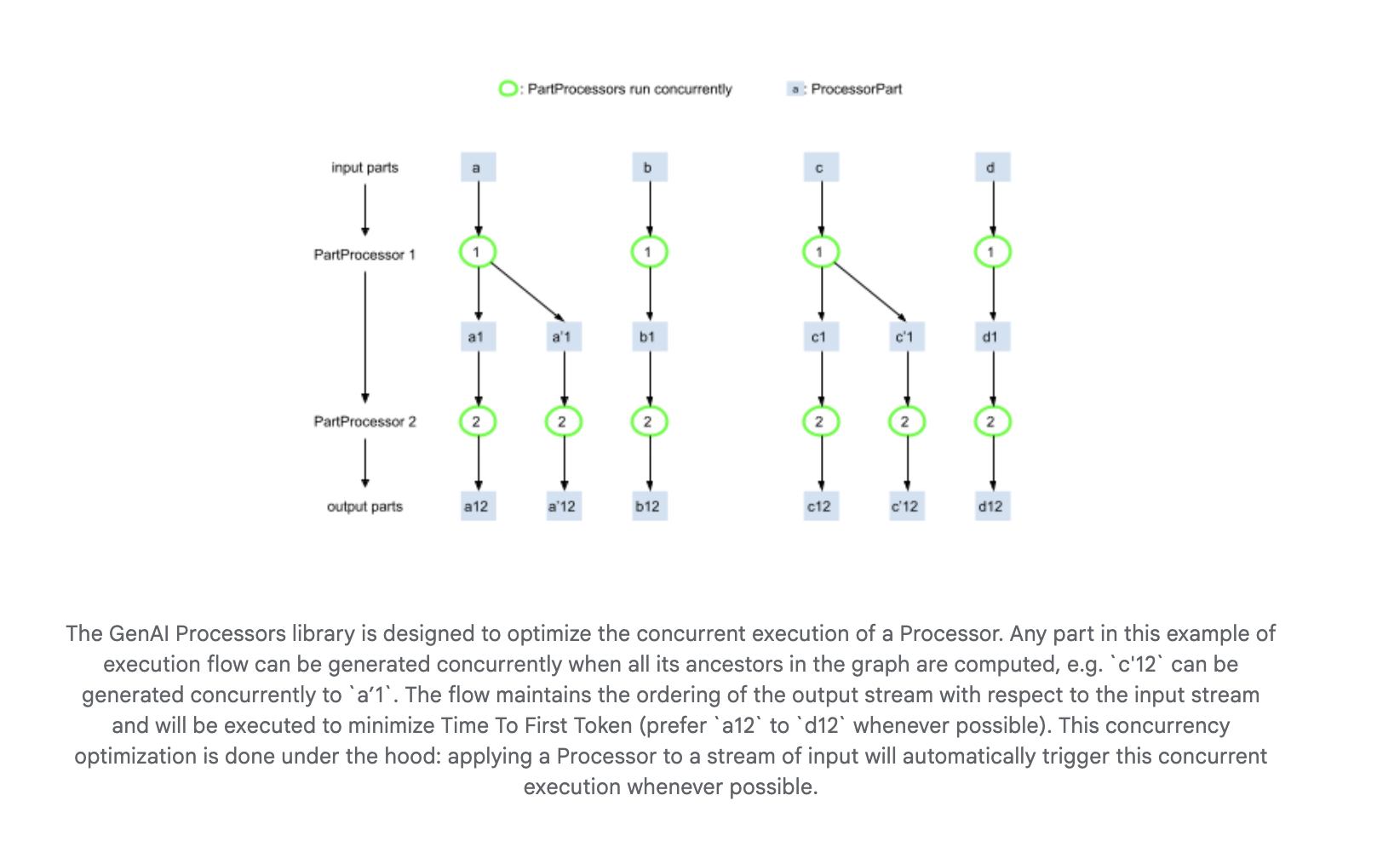

Google DeepMind recently released GenAI Processors, a lightweight, open-source Python library built to simplify the orchestration of generative AI workflows—especially those involving real-time multimodal content. Launched last week, and available under an Apache‑2.0 license, this library provides a high-throughput, asynchronous stream framework for building advanced AI pipelines.
Stream‑Oriented Architecture
At the heart of GenAI Processors is the concept of processing asynchronous streams of ProcessorPart objects. These parts represent discrete chunks of data—text, audio, images, or JSON—each carrying metadata. By standardizing inputs and outputs into a consistent stream of parts, the library enables seamless chaining, combining, or branching of processing components while maintaining bidirectional flow. Internally, the use of Python’s asyncio enables each pipeline element to operate concurrently, dramatically reducing latency and improving overall throughput.
Efficient Concurrency
GenAI Processors is engineered to optimize latency by minimizing “Time To First Token” (TTFT). As soon as upstream components produce pieces of the stream, downstream processors begin work. This pipelined execution ensures that operations—including model inference—overlap and proceed in parallel, achieving efficient utilization of system and network resources.
Plug‑and‑Play Gemini Integration
The library comes with ready-made connectors for Google’s Gemini APIs, including both synchronous text-based calls and the Gemini Live API for streaming applications. These “model processors” abstract away the complexity of batching, context management, and streaming I/O, enabling rapid prototyping of interactive systems—such as live commentary agents, multimodal assistants, or tool-augmented research explorers.

Modular Components & Extensions
GenAI Processors prioritizes modularity. Developers build reusable units—processors—each encapsulating a defined operation, from MIME-type conversion to conditional routing. A contrib/ directory encourages community extensions for custom features, further enriching the ecosystem. Common utilities support tasks such as splitting/merging streams, filtering, and metadata handling, enabling complex pipelines with minimal custom code.

Notebooks and Real‑World Use Cases
Included with the repository are hands-on examples demonstrating key use cases:
- Real‑Time Live agent: Connects audio input to Gemini and optionally a tool like web search, streaming audio output—all in real time.
- Research agent: Orchestrates data collection, LLM querying, and dynamic summarization in sequence.
- Live commentary agent: Combines event detection with narrative generation, showcasing how different processors sync to produce streamed commentary.
These examples, provided as Jupyter notebooks, serve as blueprints for engineers building responsive AI systems.
Comparison and Ecosystem Role
GenAI Processors complements tools like the google-genai SDK (the GenAI Python client) and Vertex AI, but elevates development by offering a structured orchestration layer focused on streaming capabilities. Unlike LangChain—which is focused primarily on LLM chaining—or NeMo—which constructs neural components—GenAI Processors excels in managing streaming data and coordinating asynchronous model interactions efficiently.
Broader Context: Gemini’s Capabilities
GenAI Processors leverages Gemini’s strengths. Gemini, DeepMind’s multimodal large language model, supports processing of text, images, audio, and video—most recently seen in the Gemini 2.5 rollout in. GenAI Processors enables developers to create pipelines that match Gemini’s multimodal skillset, delivering low-latency, interactive AI experiences.
Conclusion
With GenAI Processors, Google DeepMind provides a stream-first, asynchronous abstraction layer tailored for generative AI pipelines. By enabling:
…this library bridges the gap between raw AI models and deployable, responsive pipelines. Whether you’re developing conversational agents, real-time document extractors, or multimodal research tools, GenAI Processors offers a lightweight yet powerful foundation.

Asif Razzaq is the CEO of Marktechpost Media Inc.. As a visionary entrepreneur and engineer, Asif is committed to harnessing the potential of Artificial Intelligence for social good. His most recent endeavor is the launch of an Artificial Intelligence Media Platform, Marktechpost, which stands out for its in-depth coverage of machine learning and deep learning news that is both technically sound and easily understandable by a wide audience. The platform boasts of over 2 million monthly views, illustrating its popularity among audiences.