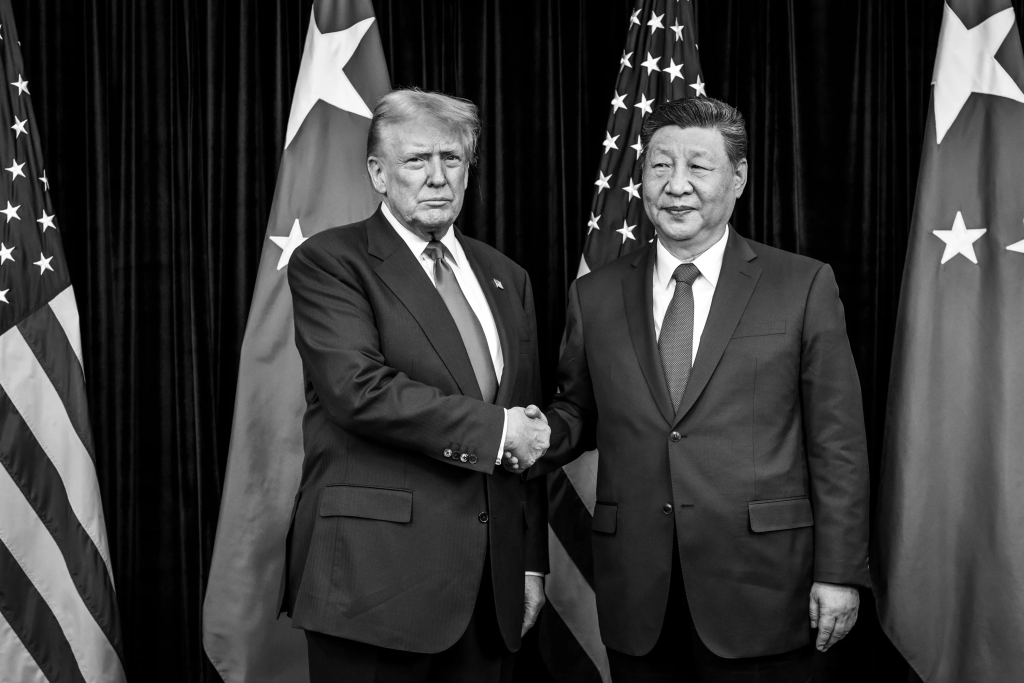

President Trump flew to Beijing, brought Jensen Huang along at the last minute, and left two days later, telling reporters that “something could happen” on chip exports. Nothing did. Not a single Nvidia H200 has shipped to China since Trump first authorised the sales in December 2025, and US Trade Representative Jamieson Greer told Bloomberg that semiconductor controls were not even on the bilateral agenda.
The summit theatre obscured a more interesting development underneath it. The H200 isn’t stuck because Washington won’t allow it. Washington already has. Roughly 10 Chinese firms, including Alibaba, Tencent, ByteDance, and JD.com, hold approved US export licences for up to 75,000 units each, with Lenovo and Foxconn authorised as distributors. The chips aren’t moving because Beijing won’t let its own companies take delivery.
Two frameworks, one deadlock
The mechanics of the stalemate are worth understanding clearly. US rules require that all H200 chips ordered by Chinese clients be used only in China. Beijing, meanwhile, has instructed Chinese tech companies to limit their use of Nvidia chips to overseas operations while supporting domestic manufacturing. The two requirements are mutually exclusive.
Chips cleared for export cannot legally be deployed where Beijing wants to deploy them, and Beijing won’t authorise the domestic use the US licences require, according to Implicator.

Commerce Secretary Howard Lutnick stated at a Senate hearing last month that Chinese firms are trying to keep their investment focused on domestic suppliers, including Huawei. Beijing’s State Council has also ordered a supply-chain security review aimed at cutting dependence on US semiconductors.
The policy contradiction is not accidental. That is the point.
What Huawei gained while diplomats talked
The days around the summit produced several data points that matter more for the long term than Trump’s parting comment. DeepSeek confirmed its latest model had been optimised to run on Huawei processors. Tencent’s chief strategy officer said Chinese GPU supply would increase progressively through 2026, and an Alibaba executive said its T-Head proprietary GPUs had achieved scaled mass production.
This follows the April launch of DeepSeek V4, which adapted the model for Huawei’s Ascend chips — the first major Chinese frontier model to do so in training, not just inference. What the summit week confirmed is that the shift is no longer experimental. It is now a supply-chain policy. Nvidia’s China revenue has fallen to roughly 5% in recent quarters, down from above 20% before export controls tightened. The company’s own guidance for the current quarter assumes zero revenue from China.
Huang’s last-minute inclusion in the delegation–Trump called him directly after seeing media coverage that he had not been invited–suggested urgency. The outcome suggested the limits of what CEO diplomacy can achieve when the obstruction is structural, not procedural.
The read for the AI industry
The stalemate matters beyond bilateral optics. Chinese AI platforms are now operating under a domestic mandate to build on Huawei’s compute stack. The question of which AI hardware architecture becomes dominant in the world’s second-largest AI market is being answered not by technical benchmarks but by government directive.
Beijing steering platforms toward Huawei Ascend chips rather than Nvidia H200S is not just a trade posture. It is a structural bet that the performance gap will close fast enough that being locked into the domestic stack is manageable. DeepSeek V4’s results suggest it may be right, at least for inference workloads.
Trump said something could happen. Greer said the decision is sovereign for China. Both are true, and neither changes the current position: the H200 deal is approved, licensed, and frozen, with Huawei filling the space it leaves behind.
(Image source: The White House)
See Also: Can China’s chip stacking strategy really challenge Nvidia’s AI dominance?
Want to learn more about AI and big data from industry leaders? Check out AI & Big Data Expo taking place in Amsterdam, California, and London. The comprehensive event is part of TechEx and co-located with other leading technology events. Click here for more information.
AI News is powered by TechForge Media. Explore other upcoming enterprise technology events and webinars here.